The Great Asian "Nut" Confusion: Fox Nuts vs. Lotus Seeds vs. Lily Nuts Explained
Have you ever stood in the aisle of an Asian grocery store, or browsed snacks online, completely confused by the labeling? You pick up a bag that looks like healthy popcorn labeled "Lotus Seeds," but next to it is another bag of hard, chickpea-looking things also labeled "Lotus Seeds."
Then, you see something called "Lily Nuts" that doesn't look like a nut at all.
If you are confused, you are not alone. These three items—Fox Nuts, Lotus Nuts, and Lily Nuts—are frequently mixed up due to translation errors, similar aquatic origins, and misleading packaging.
It’s time to clear up the confusion once and for all. Here is your definitive guide to knowing what you are buying and how to eat it.
The Core Confusion: Why Mix Them Up? Fox Nuts vs. Lotus Seeds vs. Lily Nuts ?
Before we dive into the specifics, why is this so confusing? The main culprit is mislabeling.
The popular, puffy snack known as Fox Nut (or Makhana) is very often incorrectly translated on packaging as "Lotus Seed." However, they are two completely different botanical items with vastly different culinary uses.
Let’s break them down one by one.
1. Fox Nuts (Makhana / Gorgon Nuts)
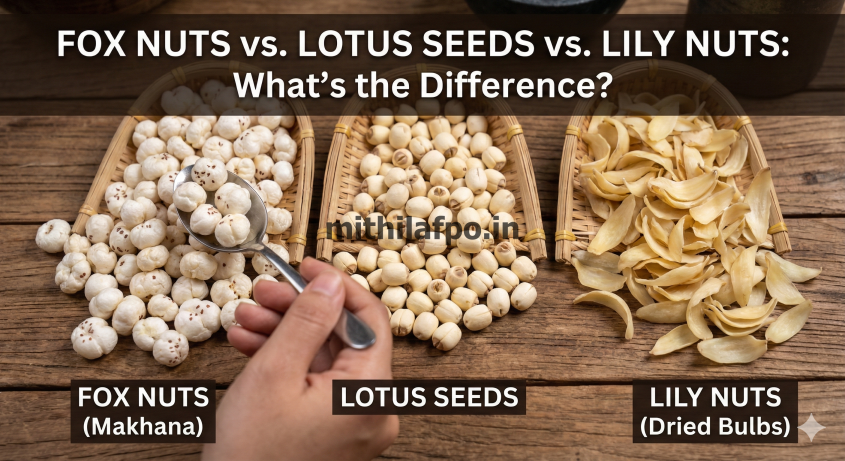
If you are eating something that looks and feels like healthy, hull-less popcorn, you are eating a Fox Nut.
What They Actually Are
Contrary to popular belief (and many packages), these are not from the Lotus flower. Fox nuts are the seeds of the Prickly Water Lily (Euryale ferox), a plant with giant floating leaves native to Eastern Asia.
Appearance, Taste, and Texture
Fox nuts are almost always sold in their "popped" form. They are white, puffy, spherical, and very light. On their own, the taste is bland and neutral. Their texture is airy and slightly chewy, but they become very crunchy when roasted.
How to Eat Them
Because they are flavor sponges, they are incredibly versatile:
- The Healthy Snack: Roasted with ghee (clarified butter), turmeric, salt, and black pepper. This is the most common way to eat them in India, where they are called Makhana.
- Curries: Used in rich, creamy Indian curries like Makhana Kaju Curry.
- Desserts: Simmered in milk and sugar to make a pudding called Kheer.
2. Lotus Nuts (Lotus Seeds)
These are the "true" lotus seeds, but you won't be snacking on them like popcorn.
What They Actually Are
These are the actual seeds found in the seed head of the iconic Lotus flower (Nelumbo nucifera).
Appearance, Taste, and Texture
Lotus seeds do not pop. They look like skinned chickpeas or pale peanuts—hard, smooth, oval-shaped, and off-white.
When raw, they are hard. When cooked (usually boiled), they take on a soft, crumbly, creamy texture, similar to a boiled chestnut or a cooked chickpea. The flavor is subtle and slightly sweet.
How to Eat Them
You will mostly find these in traditional Chinese and Southeast Asian cuisine:
- Mooncakes & Buns: They are boiled and mashed with sugar and oil to create the smooth, sweet lotus seed paste found inside traditional mooncakes and steamed buns.
- Soups: Added to savory soups or sweet dessert soups (tong sui) for texture.
3. Lily Nuts (Dried Lily Bulbs)
The name here is the biggest trick—these aren't nuts at all!
What They Actually Are
"Lily nuts" are actually the dried, fleshy scales of the Lily flower bulb (Lilium). Unlike the aquatic Fox and Lotus plants, this is a terrestrial (land) plant. In Chinese, they are known as Bai He.
Appearance, Taste, and Texture
They don't look like seeds. They look like small, curved, boat-shaped strips of dried onion or pale yellow flower petals. Their texture is distinctively starchy and chewy, and the flavor is mildly sweet.
How to Eat Them
Lily bulbs are highly valued in Traditional Chinese Medicine (TCM) and cuisine, often used for their supposed cooling properties and to soothe coughs.
- Stir-fries: Rehydrated and stir-fried with vegetables like celery and carrots for a crunchy-chewy texture contrast.
- Herbal Soups: A common ingredient in slow-cooked Cantonese restorative soups.
Summary at a Glance
Still distressed? Here is a quick cheat sheet to remember the difference:
| Feature | Fox Nut (Makhana) | Lotus Nut (Seed) | Lily Nut (Bulb) |
| Looks Like: | Popcorn ball | Skinned chickpea | Dried onion strip |
| Texture: | Airy and puffy | Hard (raw) / Creamy (cooked) | Starchy and chewy |
| Can you pop it? | Yes | No | No |
| Best for: | Roasted snacks | Mooncake paste | Herbal soups |
Conclusion
The next time you are shopping, ignore the English label and look at the product itself. If it's puffy and white, grab it for your next movie night snack—it's a Fox Nut. If it looks like a hard bean intended for a soup, it's a Lotus Seed. And if it looks like dried petals, you've found Lily Bulbs.
Now that the confusion is cleared up, you can confidently explore the distinct culinary worlds of all three!
Now that you’ve mastered the difference between these three unique ingredients, it’s time to source the best. We are a leading supplier of high-quality Fox Nuts (Makhana). Looking for stock? [Click Here to contact us for bulk enquiries or You can Click Here to Visit Our Location].